Public vs Private Facebook Group: Which One Is Right for You?
Not sure whether to make your Facebook group public or private? See the key differences, pros, cons, and which setting grows your community faster in 2026.

You're creating a Facebook Group. Facebook's question is: Public or Private?
The majority of people choose one without giving it much thought. Later they wonder why their group isn't growing as they had hoped, or why the wrong people keep coming to them.
It makes a huge difference whether you decide on a public Facebook or private Facebook group. Who can find you. Who are the intended recipients of your material. How you manage members. And the performance of your group in fulfilling its task.
This guide provides you a definite answer. You'll end up knowing which setting will suit your objective, and why the new Facebook updates will impact your choice.
What Is a Public Facebook Group?
A public Facebook group is open to all. It's searchable by anyone on Facebook, can see all of its members without joining, and can see all of its posts.
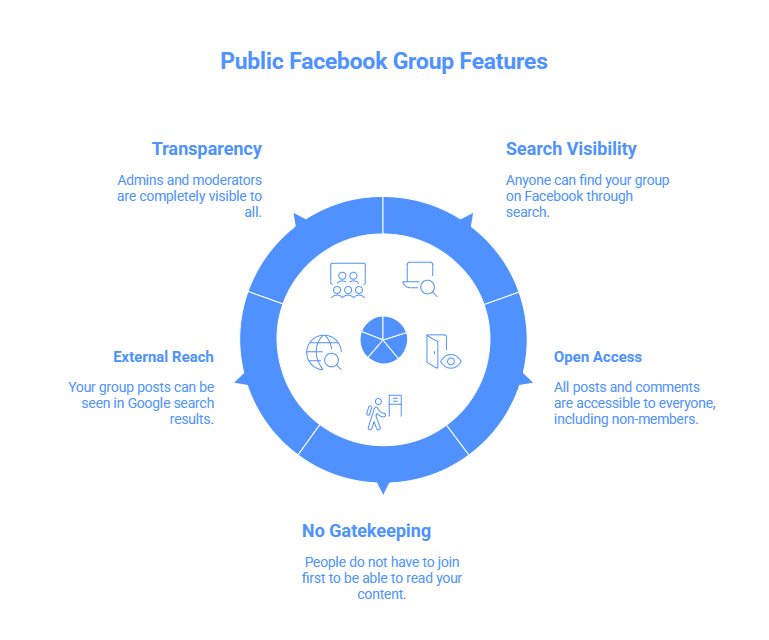
If the person is searching for something related to your group, your public group will appear in the search results. They can read your content, see it is active and useful and choose to join. That's the real benefit of listing publicly.
The definition of public in action:
- Search Visibility: Anyone can find your group on Facebook through search.
- Open Access: All posts and comments are accessible to everyone, including non-members.
- No Gatekeeping: People do not have to join first to be able to read your content.
- External Reach: Your group posts can be seen in Google search results.
- Transparency: Admins and moderators are completely visible to all.
Advantages of a Public Facebook Group
1. Information is easy to access
Anyone can read your posts, view member activity, and absorb content regardless of membership status. This is ideal for businesses sharing public product updates, reviews, or mass educational materials.
2. Better reach for public awareness
Use public groups for social causes, community projects or campaigns. No hassle for non-members to read, share and spread your content. Maximum reach, no gate.
3. More members overall
If not ready to commit, then lurk first. If they see content that's active before they subscribe, they're more likely to ask for it. Most public groups expand in size more rapidly than private groups.
4. Google indexes your content
Any public posts made to Facebook groups show up in Google search results. Your content is found outside of Facebook as well, which also means that you get a traffic source for free without putting in any effort.
Drawbacks of a Public Facebook Group
- Spam is harder to control. The group is visible to everybody. Bad actors can post before the admins can catch them. Moderation workload is much greater.
- No content privacy. Any post by your members is accessible to the public. This turns people off, as they are not willing to share their personal experiences or ask some of the questions that could be considered sensitive.
- Fake accounts are more common. If there is no approval gate, fake profiles make it right in. They are more likely to be attracted by public groups.
- Weaker engagement per member. Lurkers are people who add to your count but don't post often. The engagement rate tends to be lower with public groups than with private groups.
- Data can be copied or misused. Any member of a group can easily publish a screenshot of an open content, misrepresent it, or publish it.
To boost your public group's growth, you can link it to your personal profile. Affiliating a Facebook group with a personal profile helps your network discover the group naturally. You don’t need to promote it manually every time.
What Is a Private Facebook Group?
A private Facebook group restricts access to its content to those who are not members of that group. The group is still visible in Facebook search, where people can see the name, description and the number of members, but all posts are hidden until a person joins and is approved.
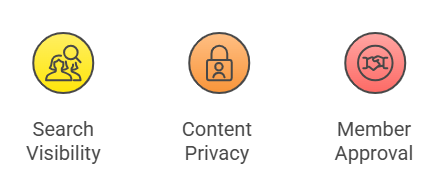
Private Groups can be located by performing a search on the Facebook search bar. These groups are displayed privately, with a group size, and Facebook group description, unlike public groups.
There's also a second option for private groups: Hidden. A hidden private group is not actually listed in search. It can only be accessed by those who have been invited or given a link.
Here's what private means in practice:
- Search visibility: The group shows up in Facebook search (unless Hidden).
- Content Privacy: Posts, comments, and the member list are hidden from the public.
- Member Approval: All new members should apply for membership and get approved by an admin.
Facebook now allows private group admins to switch to public. Past posts stay protected; only new content becomes visible after the switch. The old rule that private was permanent no longer applies.
Are Private Facebook Groups Really Private?
One of the most often asked questions about Facebook groups is this one. The answer is not straightforward, it's: mostly yes, but not entirely.
Here's what IS private in a private group:
- Posts and comments, only approved members can see
- The member list, not visible to non-members
- Photos and files, shared inside the group
Here's what is NOT private:
- The group name and description, visible to anyone in search
- The number of members, publicly visible
- Who the admins and moderators are, publicly visible
Another thing to note, Facebook is able to view all content in any group. Private is private between other Facebook users, not between Facebook and other Facebook users.
Furthermore, if one of the members screenshots your content and posts it elsewhere, there's nothing you can do about it..
Advantages of a Private Facebook Group
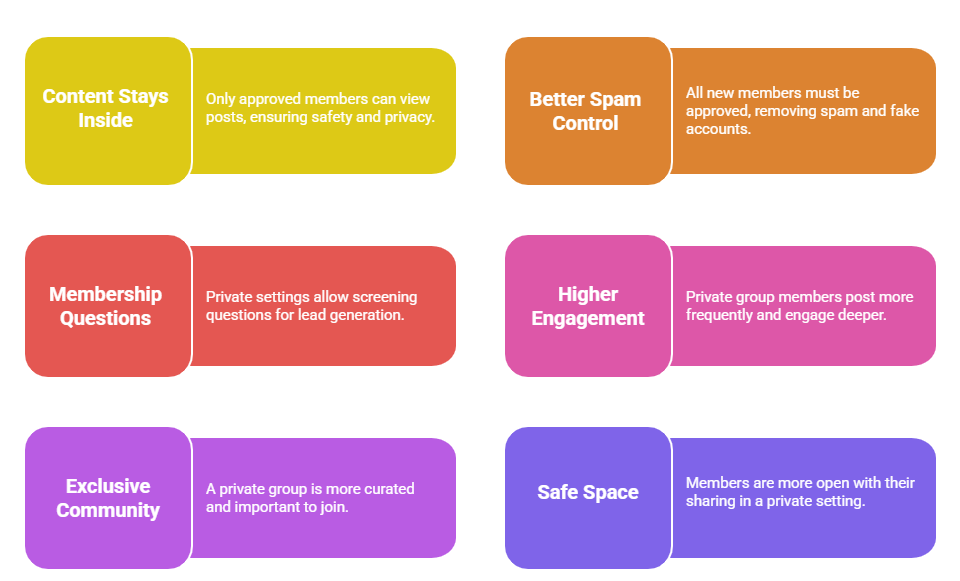
1. Content stays inside the group
Only approved members will be able to view your posts. This ensures that the content is safe, conversations stay on topic and no one has to worry about a third party seeing into the conversation.
2. Better spam and fake profile control
All new members must be approved. You make the call on who receives access. This can remove a large percentage of spam, fake accounts and bad actors before they even get to your content. If you'd like to expand your moderation team, refer to the guide to adding multiple admins and moderators to your group.
3. Membership questions for lead generation
Private settings allow you to ask up to three screening questions. This makes it simple to manage the setting membership questions needed to qualify for joining a Facebook
group, such as collecting email addresses or identifying a user's biggest professional challenge.
However, here comes an issue. Facebook hides those answers as soon as you approve a person. Later they are virtually impossible to locate. But Groupboss eliminates this, all group members' responses are automatically uploaded to a Google Sheet as soon as they click approve, (and their email automatically goes to Mailchimp, ActiveCampaign, or 30+ other tools). There is no need to do any manual labor.
4. Higher quality engagement
On average, private group members post more frequently, engage deeper, and stay longer. These Facebook group engagement tips will help you brainstorm more ideas on how to keep your community active.
5. Exclusive community feel
People appreciate what they have to work for. A private group is more curated and more important to join. This perception translates into better loyalty and lower member turnover.
6. Safe space for honest conversation
When outsiders can't see their posts, members are more open with their sharing. It is most important for groups such as support groups, professional groups, or any group where it's not safe to be vulnerable.
Drawbacks of a Private Facebook Group
Private groups aren't perfect. It has some drawbacks also. Here are the real downsides:
- Slower growth. It's easier to get people on board without content. The group must be marketed externally so that people will come to the door.
- More admin time. All new members must be reviewed and approved. This starts to be a day-to-day activity without a moderator team for fast-growing groups.
- No Google visibility. Private group content isn't indexed by search engines. You won't get organic traffic from Google.
Public vs Private Facebook Group: Side-by-Side Comparison
Here's a full breakdown of the key differences between both settings:
Which One Should You Choose?
The best way to make the decision is to do it straight away:
Choose a public group if:
- You are looking to make the world aware of your brand or gain widespread attention in a short amount of time.
- You are promoting a campaign or cause that would benefit from high visibility.
- The content is not sensitive and it's okay if anyone sees it.
- You are looking for traffic and you want Google to have that traffic.
Choose a private group if:
- The aim is to build community, lead nurture or engagement.
- The idea of watching things and letting people in. The concept of monitoring what you see and who you let in.
- You are gathering data about your members by having questions about membership
- You are operating a paid community, mastermind or support group
- Allowing your members to share personal or professional experiences in a safe environment.
In most cases, a private group is more beneficial to most business or community builders. Engagement is better, leads are generated automatically, and the community culture is more easily maintainable. And, if you ever needed to switch to public, Facebook now allows you to do just that.
How to Create Your Facebook Group
Same procedure, just choose your privacy setting when you set up.
From mobile:
- On your Mobile homepage. Click on the Group menu in the bottom nav.

2. Click the + at the top. A menu with “Create a Post” and “Create a Group” will slide in from bottom. Click on the “Create a Group."

3. Type in your group name and choose Public or Private in the Privacy section.

4. Private is the option for Visible (search appears) or Hidden (invite only). Select your preference.

5. Now, click “Create.” Inviting friends to Facebook groups is optional at this stage. You can invite people or skip this stage by clicking on the (X) button on the top left.

That's it. Your Facebook group has created
From desktop:
- On Facebook, you will find a left-side menu with the words Groups and Group Icon on the Top Nav. You can start with clicking either of this menu.

2. Click on the “Create new group” button.

3. Type the group name, and choose Public or Private.

3. Select Visible or Hidden for Private.

5. At this stage, Facebook suggests you invite your friends. It's optional, you can do it later in your group.

6. Now, click the “Create” button. Your group is live.
A public group can be changed to private at any time in your group settings. And as of November 2025, it's now possible to convert a private group back into public too, old posts will be visible only to the members of the group, while new posts will become public.

The Bottom Line
The core distinction between a public and private Facebook group comes down to reach versus control.
Public groups scale faster to broader audiences, while private groups yield higher engagement, reliable lead generation, and complete control over community safety.
Take five minutes today reviewing your current privacy settings. If your open public business group suffers from flatline engagement, shifting to a structured private ecosystem might be the most impactful growth adjustment you make this year.
Frequently Asked Questions
What is the difference between a public and private Facebook group?
Public groups are open to everyone. Posts and the member list are viewable without joining. In a private group, non-members see nothing. Posts, comments and other members are only visible to approved members.
Are Facebook groups public by default?
No. When you create a Facebook group, you select the privacy level. Facebook does not automatically make groups public, you select either Public or Private before the group is created.
Are private Facebook groups really private?
Mostly, yeah. Posts, comments and the member list are only visible to approved members. But the group name, description, number of members and admin names are still visible to the public. And Facebook itself has access to all content in any group, regardless of privacy settings.
Can I change a private Facebook group to public?
Yes, as of November 2025, Facebook now allows private group admins to switch to public. All content posted while the group was private stays protected and remains visible only to existing members. New content posted after the switch becomes visible to everyone..
What is a hidden Facebook group?
A hidden group is a private group that cannot be found at all on Facebook. Visible to people with a direct link or invite only. It’s the highest level of privacy, great for inviting only communities, internal teams or paid exclusive groups.
Which is better for lead generation, public or private?
Private groups are much better for lead generation. They allow you to ask membership questions before they approve anyone so you get email addresses from everyone who joins. Public groups don't have a controlled entry point so you can't capture member data in the same way.
Can non-members see posts in a private Facebook group?
No. Posts and comments are only viewable by approved members. Search users see group name, description and member count, but don't see inside the group until they join and are approved.
Written By
Bayazid Hossain
He loves to write and explore content on various segments. Traveling is his favorite hobby.